
If you've spent any time in the wellness space lately, you've probably heard people talking about combining sauna sessions with cold plunge. Maybe you caught Dr. Andrew Huberman's conversation with cold and heat researcher Dr. Susanna Søberg on the Huberman Lab podcast, or you've seen clips about "contrast therapy" floating around social media. Either way, the question keeps coming up: should I be doing both?
The short answer is yes — the research is genuinely compelling. Let's break down what we know, what the protocols look like, and how this applies to us here at the studio.
Why Heat and Cold Together?
Alternating between heat and cold creates something called hormetic stress — a controlled, beneficial form of stress that forces your body to adapt. When you sit in a hot sauna, your blood vessels dilate, your heart rate increases, and your body works hard to cool itself down. When you then step into a cold plunge, the opposite happens: blood vessels constrict, inflammation decreases, and your nervous system shifts into a heightened state of alertness.
That back-and-forth isn't just uncomfortable — it's training your cardiovascular system, your stress response, and your metabolism to become more resilient. According to Huberman's breakdown of the research, this combination activates heat shock proteins for cellular repair, triggers the release of norepinephrine and dopamine (the neurotransmitters behind focus, mood, and energy), and creates a cardiovascular workout that goes well beyond just sitting still.
What the Research Shows
The bulk of the sauna research comes from large-scale Finnish population studies — and this matters, because Finnish saunas are traditional dry saunas operating at 80–100°C (176–212°F). That's the type of heat that's been studied for decades, and the results are significant: regular sauna use at these temperatures has been associated with reduced cardiovascular disease risk, lower all-cause mortality, and improved markers of metabolic health.
On the cold side, Dr. Søberg's research out of the University of Copenhagen established what's now called the Søberg Principle: to maximize the metabolic benefits of cold exposure, end on cold and let your body reheat on its own. No hot shower afterward. No warming up under a blanket. You force your body to do the thermogenic work itself, which is where the metabolic boost comes from.
The Søberg Minimums: Dr. Søberg's research suggests a weekly target of 11 minutes of total cold exposure and 57 minutes of total heat exposure, split across 2–3 sessions each, to see meaningful health benefits.
Huberman's Sauna Protocols
Dr. Huberman has outlined several heat exposure protocols depending on your goals, and all of them are based on traditional sauna temperatures (176–212°F):
For Cardiovascular Health
- Temperature: 176–212°F (80–100°C)
- Duration: 5–20 minutes per session
- Frequency: 2–3x per week, up to daily
For General Health & Mood
- Temperature: 176–212°F (80–100°C)
- Total: ~1 hour per week across 2–3 sessions
- Benefits: Reduced cortisol, improved stress tolerance, endorphin release
For Growth Hormone Release
- Frequency: Once per week or less (infrequent use is key)
- Structure: Four 30-minute sessions in one day with 5-minute cool-downs between
- State: Semi-fasted (no food for 2–3 hours prior)
- Result: Studies have shown up to 16x increases in growth hormone
Practical Tips for Combining Sauna and Cold Plunge
If you're new to contrast therapy, don't overthink it. The basic framework is simple: get hot, get cold, repeat if you want, and end on cold. Here are a few things worth knowing:
Start with heat. A 15–20 minute sauna session is a solid starting point. Get genuinely uncomfortable — not dangerously so, but enough that you're ready to leave.
Follow with cold. Step into the cold plunge for 2–5 minutes. The temperature at our studio typically sits around 39°F, which is cold enough to trigger a strong norepinephrine response without being reckless.
Repeat if you'd like. Two to three rounds of hot-to-cold is a common protocol. Each cycle builds on the last.
End on cold. This is the Søberg Principle in action. Ending on cold forces your body to generate its own heat through brown fat activation and shivering thermogenesis, which is where the metabolic benefits really kick in.
Hydrate seriously. Huberman recommends at least 16 ounces of water for every 10 minutes of sauna time. Heat and cold together are demanding — don't skip this.
One thing to note: If your primary goal is maximizing growth hormone from sauna, cold exposure between sauna rounds may blunt that response. For growth hormone, do your sauna sessions without cold. For everything else — cardiovascular health, mood, metabolism, recovery — contrast therapy is the way to go.
How This Works at Plunge Performance & Recovery
A Few Things to Know About Our Setup
We want to be upfront: Plunge Performance & Recovery does not explicitly offer contrast therapy as a packaged service. We're a cold plunge studio first. But we do have a traditional Finnish sauna on-site, and plenty of our members combine the two on their own.
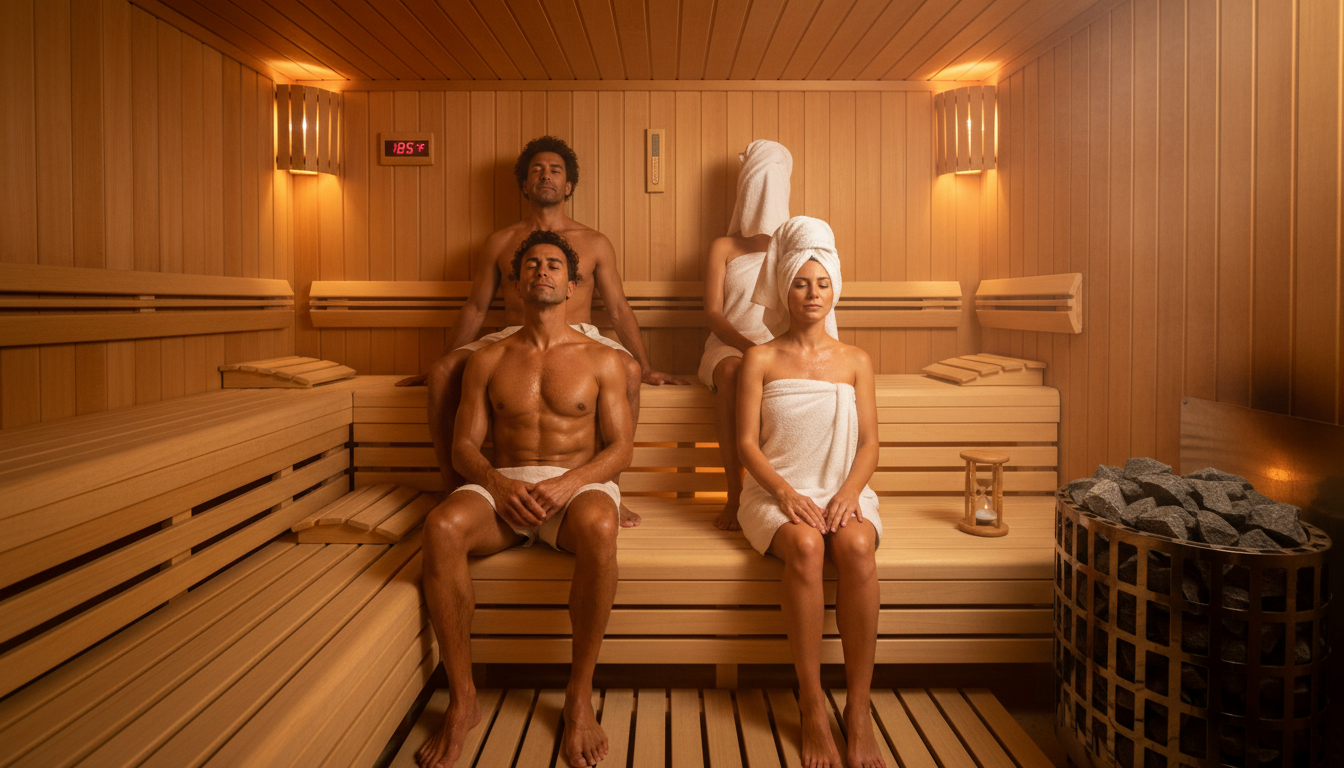
Our sauna is a traditional Finnish sauna — the same type used in virtually all of the major sauna research studies. It is not an infrared sauna. We keep it at approximately 185°F, which lands right in the middle of the evidence-based range (176–212°F) referenced by Huberman and supported by the Finnish studies. This is dry, radiant heat — the real thing.
If you want to go from sauna to cold plunge, you absolutely can — but here's the rule: you must rinse yourself off thoroughly before getting back in the cold plunge. We have an outdoor rinse area, and we are very strict about this. Sweat, oils, and anything else from the sauna cannot go into the plunge water. This is non-negotiable for water quality and for every other person who uses the plunge after you.
If you're willing to step outside and give yourself a proper rinse, you're welcome to cycle between sauna and plunge as many times as you'd like during your session.
The Bottom Line
The science behind combining sauna and cold plunge is strong, well-documented, and continuing to grow. Whether you're chasing better cardiovascular health, sharper focus, faster recovery, or just want to feel like a different person walking out than you did walking in — this combination delivers. The key is consistency. Hit those weekly minimums, follow a protocol that matches your goals, and let the adaptation happen over time.
And if you're already coming in for cold plunge, the sauna is right there. You just have to rinse off.
Book Your Session
Sources & Further Reading
Huberman Lab — Dr. Susanna Søberg: How to Use Cold & Heat Exposure to Improve Your Health
Huberman Lab — Deliberate Heat Exposure Protocols for Health & Performance
Huberman Lab — Sauna and Heat Exposure Topic Page
Huberman Lab — The Science & Health Benefits of Deliberate Heat Exposure