
The Day Mark Stopped Blaming His Age
Mark was 47 when his left knee started hurting for no reason.
Not from a fall. Not from a game. He just woke up one Tuesday and it was there — a dull, grinding ache that showed up uninvited and refused to leave. Around the same time, his sleep tracker flagged something strange: his heart rate wasn't dropping to its usual baseline at night. He felt slower in the mornings. Heavier. A headache had camped behind his eyes for ten days straight.
He mentioned it to a buddy at the gym. His buddy nodded. "Yeah, man. Happens at our age."
Mark nodded back. And that was the end of the conversation.
He told his wife the same thing. He told himself the same thing. He bought a knee brace, started going to bed earlier, and quietly accepted that this was just what 47 felt like. The CrossFit sessions that used to leave him buzzing now left him wrecked for two days. Two glasses of wine on a Friday meant a ruined Saturday. He'd lost 22 pounds over the past year and had nothing to show for it in the mirror.
This was aging. This was life. Case closed.
Except — it wasn't.
The Comfortable Lie
Mark's story isn't rare. It's what most people do the moment their body breaks from the expected: they reach for the easiest explanation, hang it on the wall, and stop asking questions.
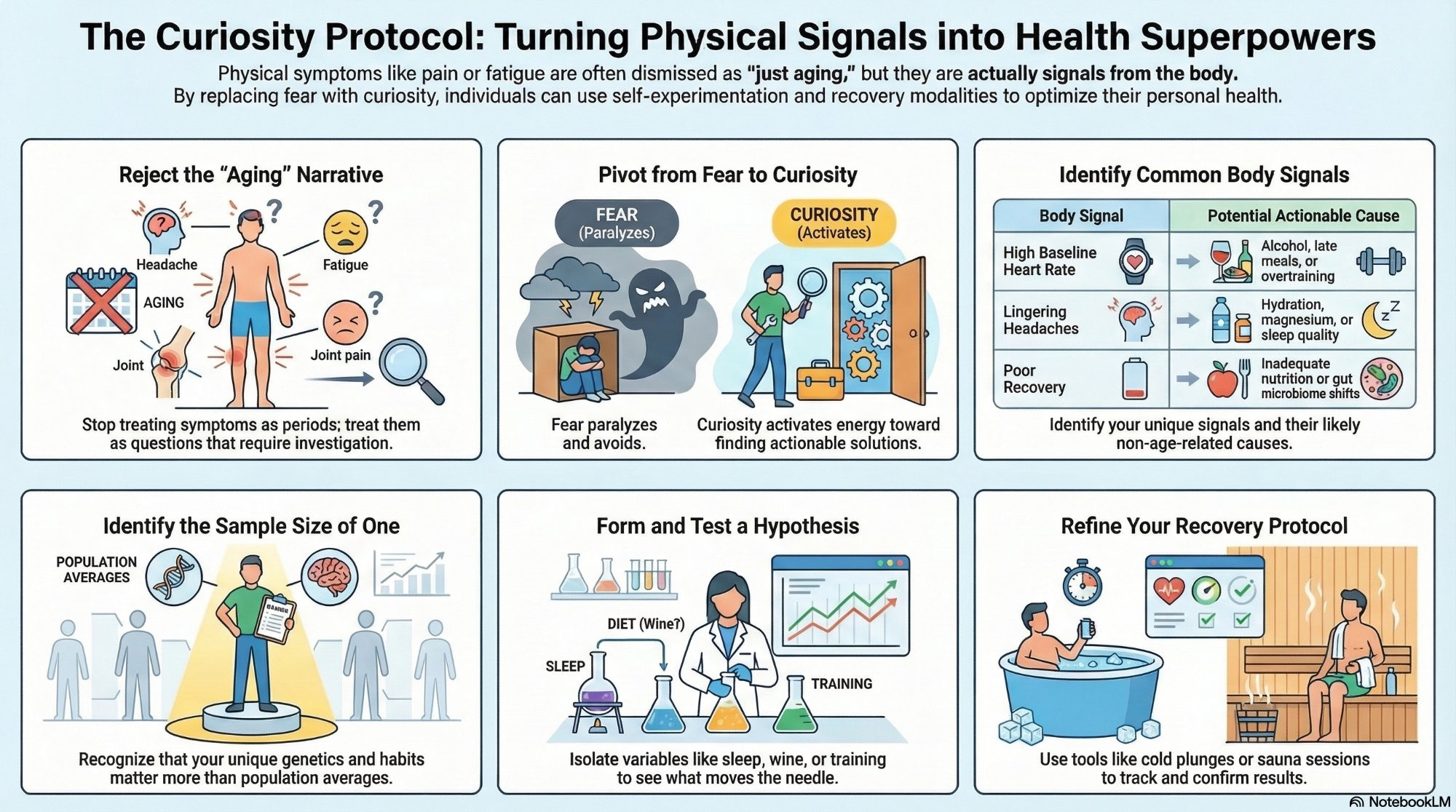
Aging is real. Bodies change. But "I'm getting older" has become a cultural sedative — a story we swallow to avoid the discomfort of not knowing. And once you swallow it, it works fast. Investigation stops. Curiosity dies. The body keeps sending signals, and you keep ignoring them.
Here's what that costs: the headache that's actually a magnesium deficiency goes unaddressed for years. The post-workout crash that's actually a nutrition timing problem becomes chronic fatigue. The disrupted sleep that's actually driven by a single late-night habit quietly erodes recovery, mood, and performance — month after month.
The problem was never aging. The problem was the story.
The Moment Everything Shifted
Three months into his new normal, Mark came across something that stopped him cold.
He was reading about the relationship between sleep quality and inflammation — mostly out of boredom — when he noticed a pattern: nearly every symptom he'd written off — the knee, the sleep, the slow recovery, the headache — appeared on a list of inflammation markers. Not aging markers. Inflammation markers.
What if these things were connected?
That one question cracked something open. Not because it had the answer. But because it replaced a period with a question mark.
This is the pivot point most people never reach — the moment fear and resignation break into genuine curiosity. And here's what makes it so powerful: fear and curiosity are the same emotion aimed in opposite directions. Both erupt when you face something unknown. Fear says don't look. Curiosity says look closer. Fear freezes you. Curiosity moves you.
Mark started looking closer.
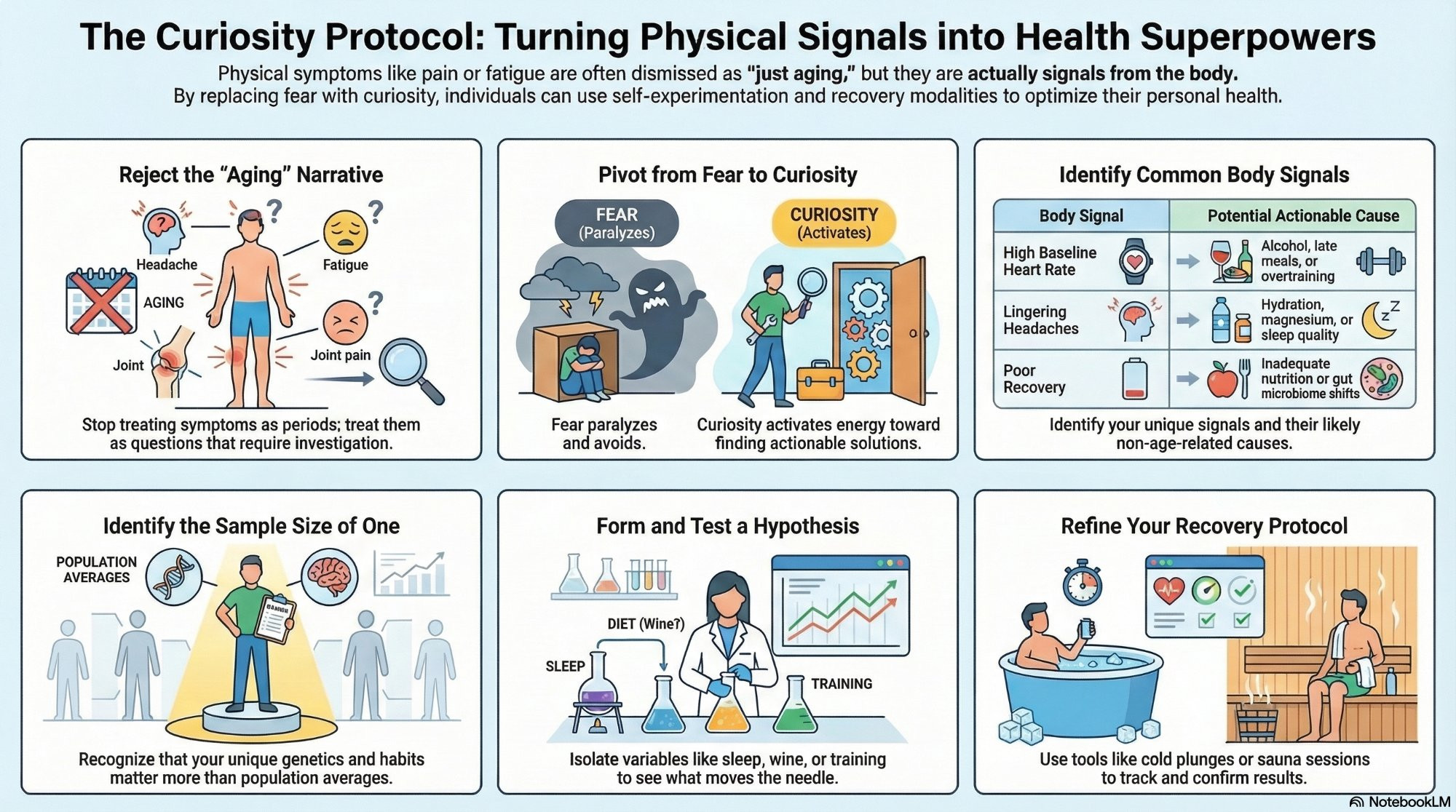
He stopped telling himself a story and started building a hypothesis. His heart rate spiked on nights he drank wine. It also spiked after late meals. It dropped — significantly — on nights he trained before 5 p.m., skipped alcohol, and ate dinner before 7. Three variables. Three levers. Suddenly, the mystery had a shape.
He wasn't aging faster than he should.
He was recovering worse than he could.
Your Body Is a System. Start Treating It Like One.
Mark didn't become a biohacker. He didn't overhaul his entire life. He started doing one thing differently: he got curious before he got comfortable with an explanation.
He began testing. Cut the late wine for two weeks — knee soreness dropped noticeably. Moved dinner earlier — sleep scores improved within days. Adjusted his training schedule to allow 48 hours between hard sessions — the post-workout crash disappeared.
No prescription. No specialist. Just paying attention to his own system with structure and honesty.
This is the core insight most health content skips over: you are a study of one. Population-level research is valuable, but it tells you what works for the average person in a controlled setting. You are not the average person. Your gut, your stress load, your sleep history, your genetics — they make your body a specific system with specific responses. The variables that wreck your sleep are harmless for someone else. The recovery protocol that works for your training partner does nothing for you.
The only way to find out what works for you is to test it.
A Place Built for That Experiment
This is exactly the philosophy behind Plunge Performance and Recovery.
We built the studio around a simple idea: give people the tools to run their own experiments. Cold plunge, sauna, hyperbaric therapy, red light therapy, PEMF, compression boots — every modality is a variable you can test, sequence, and adjust. Does red light before a cold plunge hit differently than red light after? Two weeks of testing will tell you more than any abstract study. Do sauna sessions move your sleep scores? Track it. Does hyperbaric therapy cut your post-workout soreness in half? Compare a month with and without.
Every session becomes a data point. Every data point sharpens your protocol. You stop guessing what your body needs and start knowing.
The formal research on many of these combinations is still thin. What fills that gap — and remains undervalued — is the collective intelligence of a community paying close attention to their own bodies and sharing what they find. At Plunge, that's the daily conversation. Not bro science. Not gospel. Honest, experience-based hypotheses passed between people who are genuinely curious about what works.
Someone tells you three cold plunges a week before long runs dropped their knee inflammation. You don't take that as a prescription. You take it as a starting point.
Mark Today
The knee is gone. Not managed — gone. It traced back to systemic inflammation tied to his post-workout nutrition and sleep disruption. Once he addressed the root causes, the symptom disappeared.
His sleep scores are consistently higher. His recovery time is shorter. He drinks on Friday nights when he wants to and adjusts his Saturday accordingly — no longer bewildered by the fallout, just accounting for a variable he understands.
He still does CrossFit. He feels better at 47 than he did at 44.
He didn't find a miracle cure. He found the right question.
Your Turn
The next time something shifts in how you look, feel, or perform — before you nod and say that's just age — pause.
Ask what changed. Check your sleep, stress, nutrition, and training load. Notice what you added or removed. Build a hypothesis. Test it. Adjust.
One switch separates people who just get older from people who get better: resignation versus curiosity.
Curiosity is your superpower. Come test it.